Pokebonk Moltres Boss Guide: Drought, Fire Walls and Sacred Fire
Read Moltres's three shrine phases, fire-wall gaps, magma hazards and Sacred Fire cover rules, checked in the v0.8.60 client and not yet playtested.
FAQ
How do I beat Moltres in Pokebonk?
What are Moltres's boss phases?
Is Moltres immune to Ground attacks?
Can I hide behind a pillar for Sacred Fire?
What does Moltres require for its League challenge?
Where is Moltres, and how should I prepare?
The current region data assigns Moltres to the Rocky Desert Shrine. In Classic, progress through the region’s guardians, enter its shrine through the portal and follow the shrine interaction prompt. The run code selects the sanctuary encounter at stage four. This is separate from the Moltres milestone in Survival .
Before starting, identify solid cover, a route around it and clear ground between the magma lanes. Bring a main move you have already developed and bonuses that affect it. Check your controls , recovery options and Ultimate setting before touching the shrine. There is no verified minimum player level or required item count in this guide.
The legendary health budget uses your damage and a 60-second tuning input. It is not a fixed boss HP value, a time limit or a guaranteed clear time. The boss overview explains the older official announcements behind shared rules; this page’s encounter details come from the newer dated client snapshot.
What changes in Moltres’s three phases?
Phase 1 · 100–66% HP
Fire bird
Flame sweep, Heat Wave, Air Slash, dive and pushing gusts.
Priority: leave the marked lane.
Phase 2 · 66–33% HP
Drought
Adds embers, shrinking fire rings and moving walls. Magma cracks open.
Priority: choose clear ground.
Phase 3 · Below 33% HP
Sacred Fire
The Ultimate checks cover while fire hazards and the closing arena compete for space.
Priority: cover with an exit.
Client-verified: health transitions occur at 66% and 33%, with temporary immunity during the transition. Some later patterns become denser; the second phase expands the attack pool instead of replacing every first-phase move. Attack order varies, so keep reading each warning.
Which attacks should I dodge first?
| Warning or pattern | Implemented behavior | Suggested response · not playtested |
|---|---|---|
| Flamethrower floor fan | A marked cone is followed by a sweeping projectile stream. | Leave the cone sideways before it starts; avoid retreating along its length. |
| Heat Wave | Fires several spreading volleys toward you. | Preserve a gap and avoid moving into a second volley. |
| Air Slash floor lines | Crossing lines strike after a warning. | Move out of the marked intersection rather than stopping in it. |
| Sky Attack dive lane | Moltres dives along the marked route, leaving pools; later phases add shots at the end. | Step aside, then avoid following the burning trail. |
| Fiery gust | Pushes the player away while launching projectiles. | Account for the push when selecting your route around hazards. |
| Ember circles | Marked impacts leave temporary fire pools. | Move off the marker and keep the landing area out of your return path. |
| Fire Spin | Rings contract around a point, then the center detonates. | Watch both the moving rim and the final center warning; a jump response still needs live timing tests. |
| Fire Wall | A moving wall has an open gap; phase three can send a second wall. | Line up with the gap and recheck the next wall instead of assuming the same opening. |
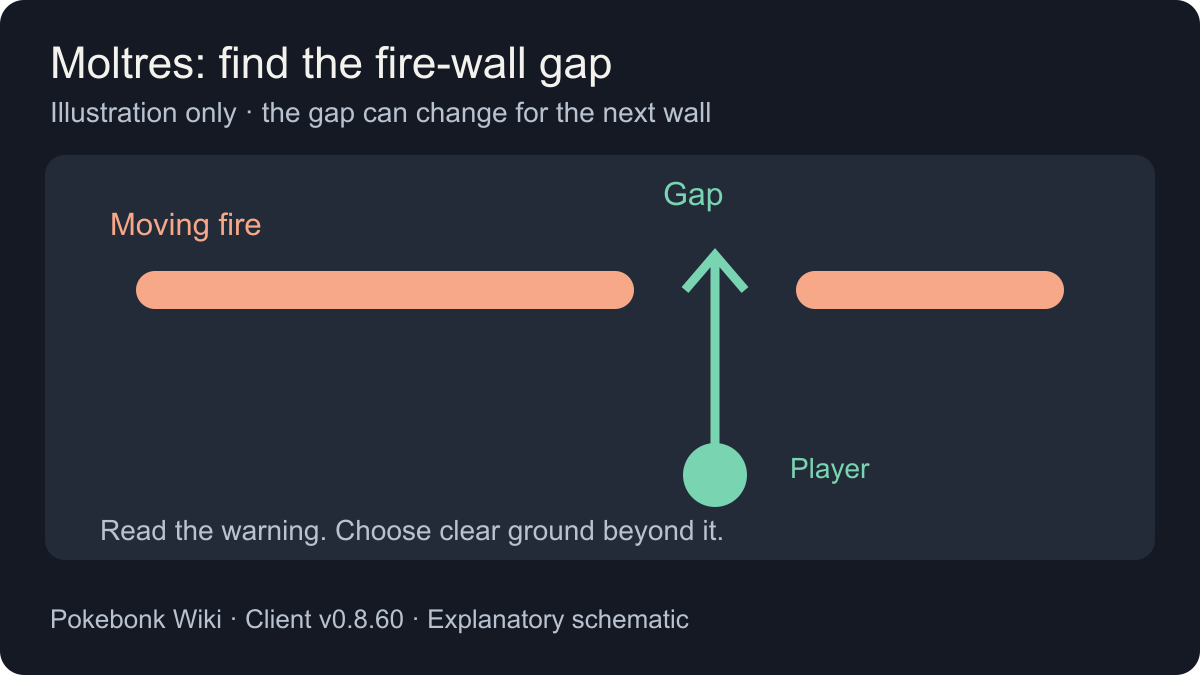
Original explanatory schematic. Positions are illustrative and do not reproduce an arena or a gameplay screenshot.
What makes Drought dangerous?
At phase two, the desert arena changes to sun and opens magma fissures. The arena checks contact with the cracks and periodically warns of an eruption along a selected fissure. Those checks are separate from the boss’s flame projectiles.
Tactical deduction: treat a glowing crack as a route boundary, move away from its eruption warning and choose a clean landing area before jumping. Do not assume standing behind cover makes the floor safe. Moltres’s fire pools add another ground hazard, so scan your escape path before committing to it.
Phase three changes the weather to sand and closes the arena boundary. A distant obstacle may become unsafe or unreachable; choose cover that remains inside the playable area rather than running into the storm.
How do I survive Sacred Fire?
Sacred Fire schedules ember attacks and a large blast. The cataclysm warning in this snapshot lasts 4.4 seconds. The shrine checks a line from the blast origin above Moltres to your character; short cover may fail even when it looks close to you.
- Read the Sacred Fire warning and find Moltres. Its Ultimate repositions the boss.
- Put intact, sufficiently tall solid cover between you and the blast. Keep the obstacle on the actual line, not beside your character.
- Avoid pools and cracks on the way. A protected blast position can still have damaging ground under it.
- Recheck after the explosion. Pillars can break, and the next attack may require moving again.
The cover gallery shows the principle, not a guaranteed safe coordinate. We have not measured which individual desert pillars block every possible player/blast height. Follow the live warning and change position if the cover has broken.
Which types and build candidates should I use?
| Attacking type | Base runtime factor against Fire/Flying | How to read it |
|---|---|---|
| Rock | ×1.8 | Two favorable matchups reach the runtime cap. |
| Water | ×1.35 | Favorable type factor; weather, move and build can change final damage. |
| Electric | ×1.35 | Favorable type factor, not a measured clear-time ranking. |
| Ground | ×0.675 | Reduced damage rather than zero in this runtime. |
Calculation, not playtest: the current client converts each reference weakness to ×1.35, resistance to ×0.8 and immunity to ×0.5, multiplies dual types and clamps the result to 0.4–1.8. For Ground, Fire’s ×1.35 and Flying’s ×0.5 give 0.675. This is why copying the reference chart’s “Ground does no damage” into a boss strategy would be misleading.
Untested candidates: Squirtle with a developed Water move and Mystic Water; an available Rock move with Hard Stone; or an Electric move with Magnet. Match the item to the move you actually have. Keep a reliable neutral move as an alternative if switching would sacrifice too many upgrades. None of these is presented as the best or a guaranteed winning build.
Compare starter play styles and move-learning requirements . The Moltres Pokédex entry and build planner use reference data; the planner does not simulate this encounter or its survivor-mode damage. For the forest shrine, see Mew’s three phases .
Does defeating Moltres recruit it?
Do not treat the fight and League recruitment as the same task. The inspected challenge lists 55 League members, defeating Moltres in Rocky Desert on Hard, and 8,000 burns in one run. These are progression conditions; they are not evidence that a Normal shrine victory immediately grants Moltres. Check the League and capture instructions in your own version. This review did not complete recruitment.
What was verified, and what remains untested?
Checked 27 October 2026 UTC, using the official version file : 0.8.60 / mvqveq60.
- Official game client : Moltres attack/phase handlers, shrine routing, desert hazards, line-of-sight cover and the runtime effectiveness function.
- Official shared data : region assignment, challenge counters and type-item tags.
- Versioned species records and type chart : Fire/Flying inputs to the factors above.
- Evidence receipt : source hashes, derived facts and limits. The files were read as text without executing downloaded game code.
Still untested: a completed fight, dodge timing, safe coordinates for individual cover pieces, current build DPS/win rates, capture outcomes and device performance. No verified Moltres fight recording is embedded here; the original gallery diagrams explain code-derived mechanics. A client patch can change the fight, so compare your version and on-screen warnings before relying on these details.
Gallery
Related Articles
guides
Pokebonk Mew Boss Guide: Three Phases and Ancestral Gene
Prepare for Mew's shrine fight: bubbles, Metronome, clones and Ancestral Gene cover, checked in the v0.8.60 client with explicit playtest limits.
pokedex
Aerodactyl in PokéBonk: Stats, Type and Evolution (#142)
Aerodactyl (#142) in PokéBonk: Rock / Flying type base stats, type matchups and the Pokédex entry, from the game's data.
pokedex
Arcanine in PokéBonk: Stats, Type and Evolution (#059)
Arcanine (#059) in PokéBonk: Fire type base stats, type matchups and the Growlithe → Arcanine evolution line, from the game's data.
Was this helpful?
Thanks for the feedback!